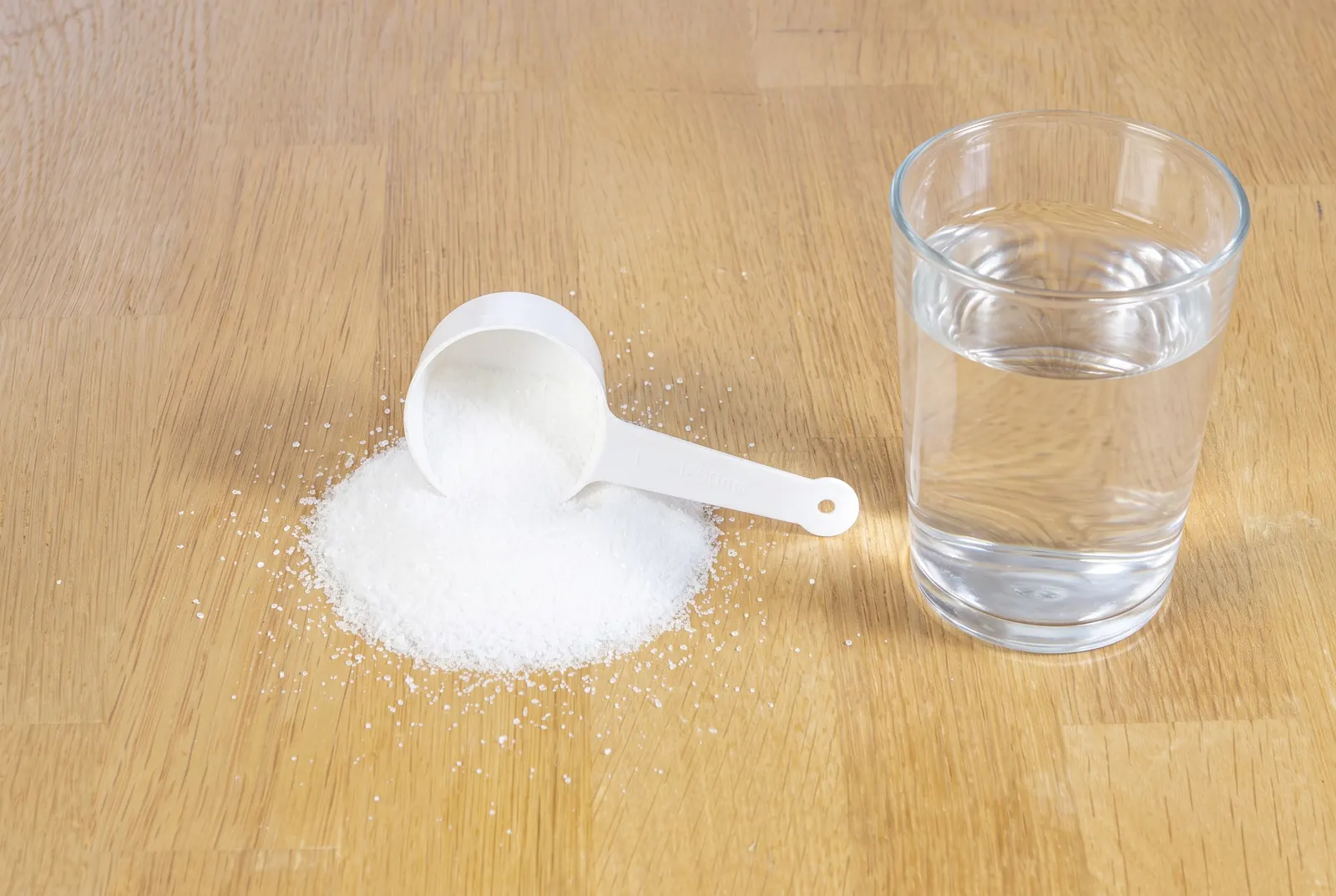
The short version
3 to 5 g of creatine monohydrate, every day. That’s the standard adult dose, and the NIH says it’s the same “regardless of sex or body size.”13 If you came for the number, there it is. If you want to know when the answer changes, grab your coffee.
How much do you already get from food?
Probably less than you think. One 5 g scoop holds the creatine of about 1.1 kg (2.4 lb) of raw steak.14 That’s a lot of steak before breakfast.
The average American gets about 0.7 g a day from food.15 That’s also why vegetarians tend to get more out of a supplement: in one study, they started lower and gained more than meat-eaters did.16
Do you need to “load”?
Loading means 20 g a day, split into four 5 g doses, for 5 to 7 days, before dropping to 3 to 5 g.2 It works. It’s just not necessary.
In the classic study, men took either 20 g a day for six days or 3 g a day for four weeks. Both groups ended up with about 20% more creatine in their muscles. The slow group just took longer.1
Two roads to the same full tank
Days until muscles held about 20% more creatine (men)
Source1
So it’s speed versus comfort. Loading gets you there in a week, with more early water weight and bigger doses for your stomach. A normal dose gets you there in 3 to 4 weeks.23 And in one small study, the body flushed out 40% to 68% of a heavy loading dose in the first three days.14 Expensive pee.
What did the studies in women use?
This is where “how much” depends on what you want.
- Young women who lifted: after a short loading phase, 5 g a day with strength training made them stronger, with more muscle (and the water in it), than training alone.17
- Women after menopause who lifted: across 7 studies, the benefits showed up at about 5 g a day or more, with strength training two to three days a week.4
- The biggest study used about 10 g a day, on purpose. These researchers had tried a smaller dose before, and they say it didn’t build muscle or strength. They think muscle gets harder to build after menopause.18
- No lifting, small dose: 1 g a day for a year, or 3 g a day for two years, changed nothing.65
For muscle after menopause, the dose that worked came with a barbell, and it wasn't the smallest one.
The brain may need more. In one small study of teenage girls with depression, the brain’s quick-energy reserve rose about twice as much on 10 g a day as on 2 to 4 g.19 One small study, though, not a recommendation.
Morning or night? Before or after the gym?
Stop worrying about this one. Four studies compared taking creatine right before training with right after, including one in adults aged 50 to 64. All found similar results.7 Timing also made no extra difference in male and female college athletes,8 and morning versus evening was “very similar” in female handball players.9
What matters is taking it every day, because creatine works by keeping your stores topped up.3 Pick the moment you’re least likely to forget. For most of us, that’s next to the coffee.
Should you take it with food?
It can help a little. In men, taking creatine with a lot of carbs helped the body keep more of it,20 and a mix of protein and carbs worked just as well.21 In plain terms: take it with a meal. Nobody needs to chug a pint of juice.
Which kind should you buy?
Look for “creatine monohydrate” on the label. It’s the plain, original form, with by far the most research behind it. No other form has been shown to get more creatine into your muscles.10
Creatine HCl is often sold as “38 times more bioavailable.” That claim comes from a test of how well it dissolves, not from human muscle.10 In one study, it showed “no benefit over” monohydrate.22
Why gummies are a gamble
Creatine slowly breaks down in water, faster when things are acidic.10 Bad news for a moist, fruity chew.
In two lab tests run by the supplement industry, about half of the gummy results failed their label claims. Two had no creatine the lab could detect at all. Every powder passed.1112 Outside scientists didn’t review these tests, and one was run by a company that sells creatine powder. So call it a warning, not a verdict. Still, plain powder is the safer bet.
Practical tipMix your creatine and drink it soon after. It keeps for a few days in plain water, but breaks down faster in acidic drinks.
What happens when you stop?
Nothing dramatic. Your muscle stores drift back to normal over about four weeks in women,17 or 4 to 6 weeks in the wider research, and never drop below where you started.2 No rebound, no crash. A nice change from most things in the supplement aisle.