Why is everyone suddenly talking about creatine for women?
For about thirty years, creatine lived in giant plastic tubs next to the protein powder, sold to men with very large necks. So when it started showing up in talk about menopause, brain fog and the 3 p.m. slump, a raised eyebrow was fair.
The surprising part: in some reports, women’s bodies make about 20% less creatine than men’s, and women eat 30-40% less of it, because most of it comes from meat and fish.4 Yet almost all the early studies were done on men.1 If you’ve ever been handed a “unisex” anything, this will sound familiar.
That’s changing. Some of the new results are solid, some are promising, and some are headlines that ran ahead of the facts. Let’s sort them out.

What is creatine, anyway?
It’s not a stimulant, and it’s not a hormone. Your liver and kidneys make about 1 g of it a day, and you get roughly another gram from food. A pound of beef or salmon has about 2 g.2 About 95% of it ends up in your muscles.1
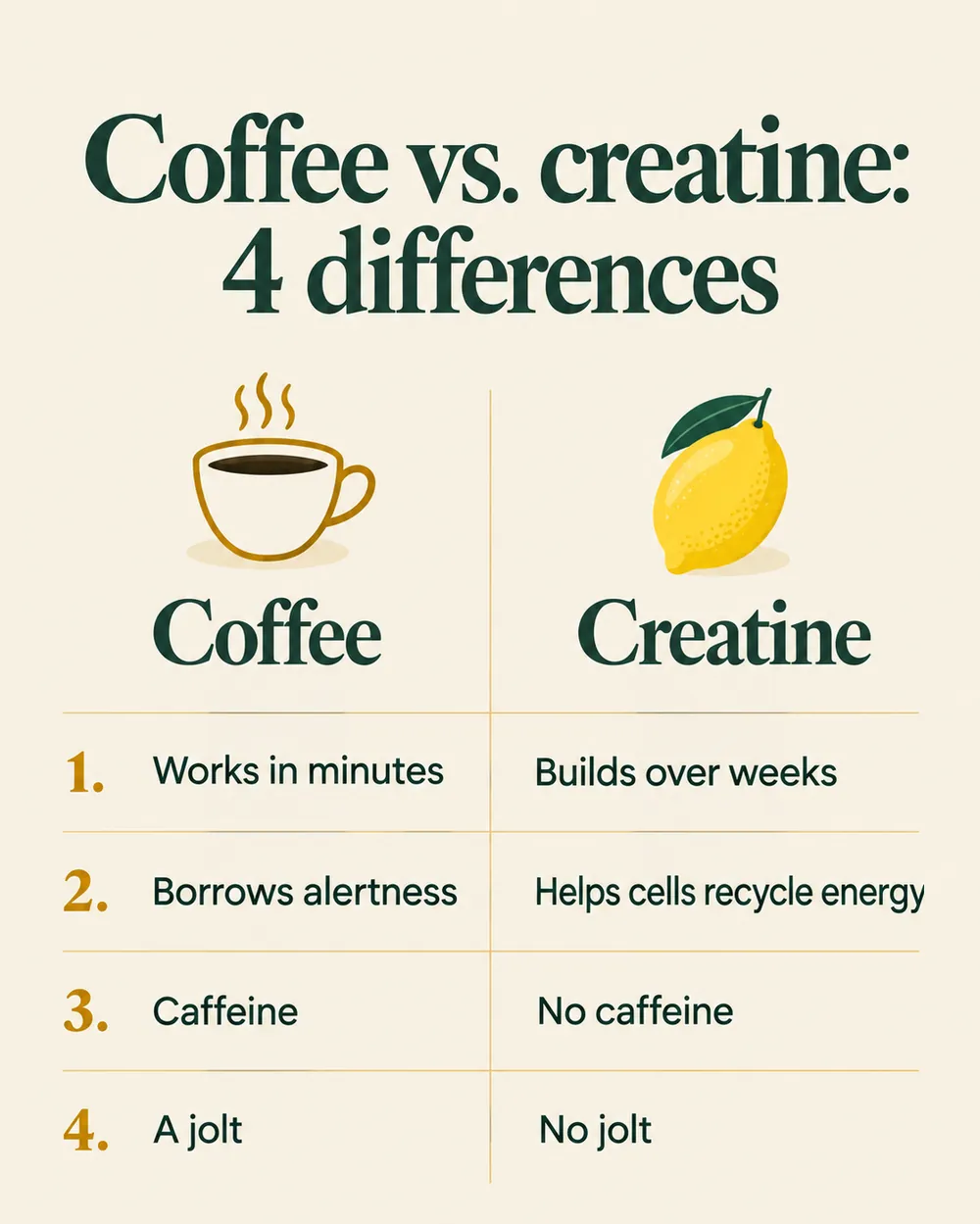
Think of it as a power bank for your muscles (the charged one, not the one that’s been dead at the bottom of your bag since 2022). When you need a quick burst, like the stairs or a heavy box, it recharges your muscles’ energy within seconds.1
On a normal diet, that power bank sits about 60-80% full. Taking creatine raises your stores by 20-40%. It fills up over days to weeks, so don’t expect a kick like coffee. And if you stop, your stores drift back to normal over about 4-6 weeks, and no lower.1
Muscle and strength: the clearest benefit
This is where creatine shines for women, with one condition: you have to train.
The first story is from 1997. Nineteen young women did 10 weeks of strength training, some with creatine and some with a dummy powder. The creatine group gained 20-25% more strength and 60% more muscle (and the water in it).5 A small, old study (the study, not the women), but it pointed the way.
After menopause, the best summary is a 2026 review that combined 7 studies with 608 women, average age about 62. Compared with training alone, creatine plus training added about 0.37 kg (0.8 lb) of muscle and about 7.5 kg (16.5 lb) on the leg press.6
The benefit showed up at 5 g a day or more, together with strength training. Studies that used 3 g a day with no training found nothing.610
So is it a muscle pill?
No. In one two-year study, 200 older women took 3 g a day with no exercise program. Their muscle didn’t change any more than the dummy-powder group’s.10
Creatine boosts the workout. It doesn't replace it.
A 2026 review of women at all life stages agreed: supplements plus exercise didn’t add much muscle, but upper-body strength improved, “particularly in studies using creatine.”7
| What they did | Who | What happened |
|---|---|---|
| Creatine + strength training, 10 weeks | 19 young women | Stronger, and more muscle, than training alone5 |
| Creatine + training, 3 months to 2 years (7 studies) | 608 women after menopause | A little more muscle, more on the leg press6 |
| 3 g a day, no exercise, 2 years | 200 women after menopause | No change in muscle or bone10 |
What about my bones after menopause?
This is where we most wanted good news. (We checked twice, hoping.)
A one-year study in 2015 looked promising. Women who did strength training with creatine lost 1.2% of the bone in part of their hip, while women on the dummy powder lost 3.9%.8
Then the same team ran a bigger, two-year study with 237 women, and that bone difference didn’t hold up. The creatine group did keep a stronger hip shape (the kind that resists bending), walked a little faster, and had a little more muscle.9 A third study, 3 g a day with no exercise, found no effect on bone at all.10 The big review’s verdict: bone density unchanged.6
Bottom line on bonesCreatine hasn't been shown to make bones denser after menopause. If bones are your main worry, start with strength training, protein, vitamin D and calcium, and a chat with your doctor about your bone scan.
Perimenopause: two small studies and a lot of headlines
If you’ve seen “creatine fixes perimenopause” on your feed, here’s everything behind it. As of 2025, a review found no study that had directly tested it.4
Two small studies have come out since. In one, 36 women around and after menopause took a low dose of a different form of creatine (under 2 g a day) for 8 weeks. The higher-dose group had quicker reaction times and more creatine in the brain than the dummy-powder group.11 The other is a short conference report: 15 women, only 5 of them in perimenopause, no dummy powder, 14 weeks of strength training. Leg strength improved, and the women in perimenopause slept better.12
So does it help? Nobody knows yet. A 15-woman conference report turning into a thousand confident Instagram captions tells you more about Instagram than about creatine. Nobody has even measured hot flashes.
Brain and mood: early, but interesting
Your brain runs on the same quick-energy reserve as your muscles,1 and it’s famously hungry (try thinking on an empty stomach at 4 p.m.). So researchers got curious.
The most famous study kept 15 young adults, 8 of them women, awake for 21 hours. They got one very big dose of creatine, about 21 g for a 132 lb (60 kg) person. About three and a half hours later, their memory and thinking speed were better, and they felt less tired than on the dummy powder.13 An older study of 128 young women found creatine helped memory in vegetarians but not in meat-eaters,14 which fits the idea that it helps most when stores are low.
The mood study is the one we find hardest to ignore. Fifty-two women with depression were starting an antidepressant, and some also took 5 g of creatine a day. They got better faster, and after 8 weeks the depression had lifted for 52% of them, versus 26% on the dummy powder.15 One study, and creatine was added to medicine under a doctor’s care, never used instead of it.
So can it clear brain fog? Maybe, but no study has tested that in women at a normal daily dose.
How much should a woman take?
The standard dose is the same “regardless of sex or body size”:2
- 3-5 g a day of creatine monohydrate, the most studied form. Your stores fill up in about 3-4 weeks.24
- An optional fast start (“loading”): 20 g a day, split into four 5 g doses, for 5-7 days, then 3-5 g a day. Faster, with more water weight early on.1
- Timing: whenever you’ll remember (for most of us, next to the coffee). Taking it every day matters more than when.
The studies in women after menopause that showed gains used 5 g a day or more, plus strength training.6 Other forms, like gummies or “buffered” creatine, haven’t been shown to work better than plain monohydrate.2

Will it make me gain weight?
A little, and it’s mostly water. A loading week usually adds 1-3 kg (2-6.5 lb), held inside the muscle, and longer studies mostly show no rise in total body water.13 If the scale matters to you, skip loading.
Is it safe for my kidneys?
The worry goes back to a 1998 report about one man who already had kidney disease.3 Since then, doses up to 30 g a day for up to 5 years haven’t been linked to more kidney problems. In the two-year study of 237 women after menopause, kidney problems were about as common on creatine as on the dummy powder.19
One tip: creatine can raise the kidney score on a standard blood test without any harm. Tell your doctor you take it before they read the number.
Will it make my hair fall out?
The scare comes from one 2009 study of 20 male rugby players whose DHT, a hormone, went up. Nobody checked their hair.16 A 2025 study that did check found no change in DHT or in how much hair people had after 12 weeks.17 Both were in men, so for women: no sign of a problem, and no direct study either.
What we don’t know yet
- Perimenopause: no proper-sized study with a dummy powder has tested regular creatine yet.1112
- Hot flashes: no study we found has measured them.
- Broken bones: no study has been big enough to tell.9
- The right dose for the brain: unknown. The sleep-loss study used one very big dose.13
- Hair in women, pregnancy, and use with hormone therapy: not studied yet.34