
The Creatine Journal

Side effects · 3 min read

Does creatine cause hair loss in women? Where the rumor came from

By the editorial team Updated 12 sources
A woman seen from behind runs her hands through long wavy hair among green plants.
Photo: Tim Mossholder / Unsplash

Short answer

No study has shown that creatine causes hair loss in anyone, and no study has checked hair in women taking it. The scare started with one 2009 study of 20 male rugby players, where a hormone called DHT went up, but nobody looked at their hair. A 2025 study that did look at hair found no change, also in men. In women, thinning hair usually has another cause worth checking.

Key takeaways

  • The only study that checked hair found no effect: 5 g a day for 12 weeks, and no change in DHT, in how much hair people had, or in how thick it was. It was in men.11
  • The DHT rumor comes from one small study of 20 men that never looked at hair, and the creatine group started with 23% less DHT.910
  • DHT matters less for women's hair: most women with female pattern hair loss don't have high levels of male-type hormones.6
  • Hair shedding in women usually has a cause you can check: childbirth, illness, big weight loss, stopping the pill, thyroid, iron or PCOS.23468
In this article
  1. How a study about rugby players ended up on your feed
  2. What that study really showed
  3. The study that finally checked hair
  4. Why DHT matters less for women’s hair
  5. So why is my hair thinning?
  6. What we don’t know yet

How a study about rugby players ended up on your feed

Of all the creatine worries, this one has the strangest origin story. In 2009, researchers gave creatine to 20 college rugby players for three weeks and measured their hormones.10 A hormone called DHT, the one linked to male baldness, went up.10

Nobody in that study looked at a single hair.

From there, the logic went: DHT causes baldness in men, creatine raised DHT, so creatine causes hair loss. Somewhere along the way “in men” fell off, and the warning landed in women’s comment sections. (A lot of things land there without their fine print.)

What that study really showed

To be fair, the number was real. During a heavy week of 25 g a day, DHT went up by 56%, and after two more weeks at 5 g a day it was still 40% higher than at the start.10

DHT in the rugby study

A hormone linked to hair loss in men. Hair itself was never checked.

After a week at 25 g a day+56%
Two weeks later, at 5 g a day+40%

Young male rugby players. Source10

Now the rest of the story:9

  • DHT stayed within the normal range.
  • The creatine group started with 23% less DHT than the dummy-powder group, which makes a rise look bigger.
  • Of 12 other studies on creatine and testosterone, 10 found no change.

A 2021 expert review put it simply: “No study has reported hair loss/baldness in humans.”9

The study that finally checked hair

It took sixteen years, but in 2025 someone finally checked. Forty-five men who lifted weights took 5 g of creatine or a dummy powder every day for 12 weeks, and the team measured their hormones and their hair, scalp photos included.11

The result: no difference in DHT, and no difference in how much hair the men had or how thick it was.11 Our favorite detail: testosterone went up in both groups, a little more on the dummy powder.11

12 weeks5 g a day vs a dummy powder
0difference in hair
0difference in DHT

Two honest catches: it was one study, and it was in men.

Why DHT matters less for women’s hair

In women, the role of male-type hormones like DHT in hair loss still isn’t fully understood. That’s why doctors dropped the old hormone-based name and now call it female pattern hair loss.6

The clues add up. Most women with it don’t have high levels of these hormones. The drugs that block DHT, which work well for men, give “less consistent results” in women. And in two studies, the genes linked to male balding weren’t linked to women’s hair loss.6

So even if creatine nudged DHT (and the best study says it didn’t), it would be pulling a weaker lever in women.

No study shows creatine causes hair loss in women. No study has looked. Both of those sentences are true.
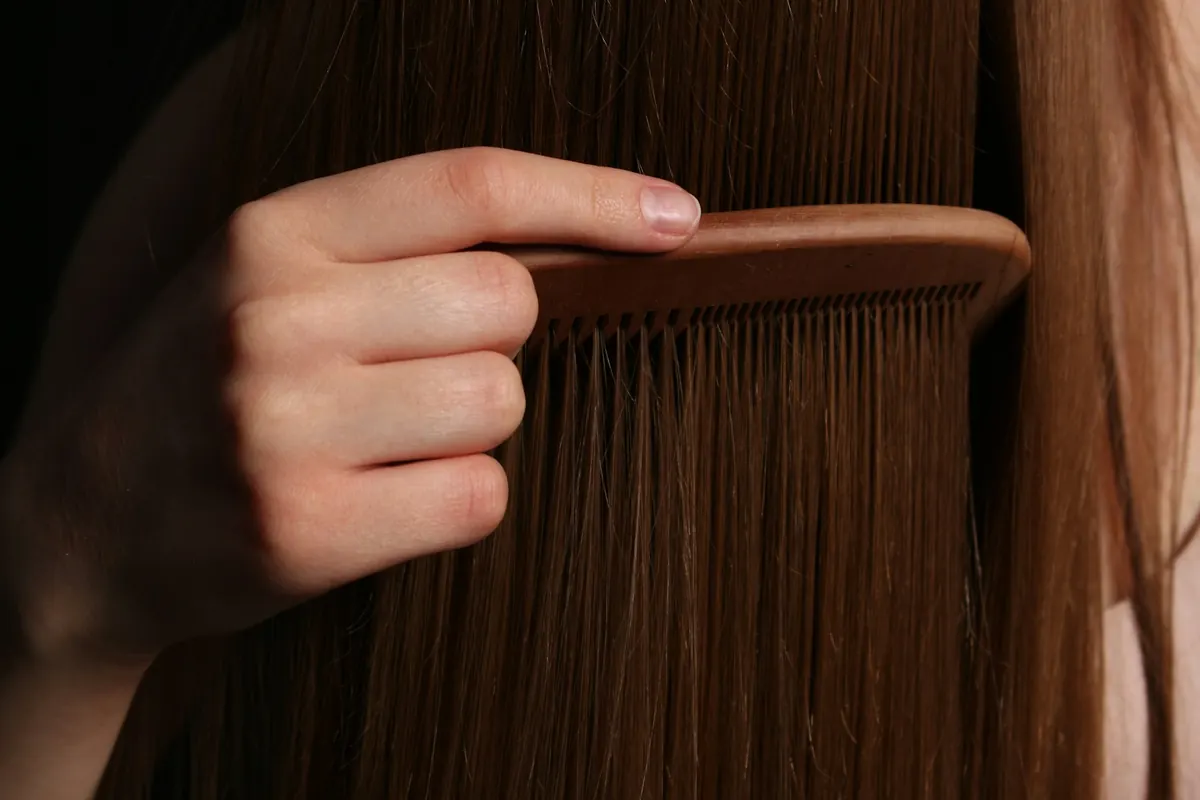
A hand runs a wooden comb through long brown hair.
Hair shedding has many causes, and most of them are worth checking first.Photo: Mariia Horobets / Unsplash

So why is my hair thinning?

First, the reassuring part: losing 50 to 100 hairs a day is normal.2 Beyond that, the usual suspects are well known:

  • Female pattern hair loss is the most common cause in women. It often starts in your 40s to 60s, is more common after menopause, and usually shows up first as a wider part or a thinner ponytail.1 One review sees a second wave of new cases between 50 and 60,6 and hair growth and thickness change around menopause, mostly at the front.7
  • Shedding after a trigger: childbirth, a high fever, surgery, a stressful stretch, losing 20 or more pounds (9 kg), or stopping the pill. It usually shows up a few months later and settles in about 6-9 months.2 After childbirth, it peaks around four months and is usually back to normal by the baby’s first birthday.3
  • Other causes: thyroid problems, PCOS, low iron or protein, some medicines, and, ironically, too much vitamin A or selenium from supplements.4

That timing matters if you started creatine recently. Shedding trails its trigger by a few months, so last week’s change is rarely the cause. The illness, crash diet or stressful month from last season often is.2 In one clinic’s records of 2,851 women with shedding, nearly half (46.5%) had low iron stores.8

Worth doingSee a dermatologist instead of guessing. They may order blood tests for things like thyroid and iron, and treatment for female pattern hair loss works best when it starts early.15

What we don’t know yet

  • Hair in women taking creatine: no study has checked it.
  • DHT in women taking creatine: not measured. One small report on 15 women found no change in estrogen (estradiol).12
  • Women already prone to hair loss, or with PCOS: not studied.
  • Big doses: the DHT rise came during a 25 g a day week,10 while the hair study used 5 g a day.11

Questions women ask

Does creatine cause hair loss in women?

No study shows it, and none has checked hair in women. The one study that did check hair, in 38 men taking 5 g a day for 12 weeks, found no change in hair or DHT.

Doesn't creatine raise DHT?

In one 2009 study of 20 male rugby players, DHT went up during a loading week of 25 g a day. But it stayed in the normal range, the creatine group started lower, and nobody checked hair. A 2025 study found no change in DHT at 5 g a day, and DHT hasn't been measured in women taking creatine.

I started creatine and now my hair is shedding. Is it the creatine?

Shedding usually shows up a few months after a trigger, like illness, high stress, surgery, childbirth, losing 20 or more pounds or stopping the pill, and settles within about 6-9 months. Thyroid problems, low iron, PCOS, some medicines and too much vitamin A or selenium can also cause it. A dermatologist can tell you which one it is.

Is my thinning from menopause?

It could be. Female pattern hair loss is the most common cause of hair loss in women. It often starts in the 40s to 60s, is more common after menopause, and usually shows up first as a wider part.

What should I ask my doctor to check?

A dermatologist may order blood tests if they suspect a health problem, a shortage or a hormone imbalance. Thyroid problems and low iron are known causes of thinning. In one large clinic, nearly half of women with shedding (46.5%) had low iron stores.

Hair loss runs in my family. Should I avoid creatine?

Nobody has studied this in women. In men, 5 g a day for 12 weeks didn't change hair or DHT. Female pattern hair loss runs in families and gets worse over time, and treatment works best when it starts early, so seeing a dermatologist about the thinning itself matters more.

Sources

  1. American Academy of Dermatology. Thinning hair and hair loss: could it be female pattern hair loss? Updated December 13, 2022. www.aad.org/public/diseases/hair-loss/types/female-pattern
  2. American Academy of Dermatology. Do you have hair loss or hair shedding? www.aad.org/public/diseases/hair-loss/insider/shedding
  3. American Academy of Dermatology. Hair loss in new moms. Updated October 2, 2025. www.aad.org/public/diseases/hair-loss/insider/new-moms
  4. American Academy of Dermatology. Hair loss: who gets and causes. www.aad.org/public/diseases/hair-loss/causes/18-causes
  5. American Academy of Dermatology. Hair loss: diagnosis and treatment. Updated December 13, 2022. www.aad.org/public/diseases/hair-loss/treatment/diagnosis-tr
  6. Ramos PM, Miot HA. Female pattern hair loss: a clinical and pathophysiological review. An Bras Dermatol. 2015;90(4):529–43. pmc.ncbi.nlm.nih.gov/articles/PMC4560543/
  7. Mirmirani P. Hormonal changes in menopause: do they contribute to a 'midlife hair crisis' in women? Br J Dermatol. 2011;165 Suppl 3:7–11. pubmed.ncbi.nlm.nih.gov/22171679/
  8. Karakoyun Ö et al. Retrospective review of 2851 female patients with telogen effluvium: a single-center experience. J Cosmet Dermatol. 2025;24(2):e70037. pmc.ncbi.nlm.nih.gov/articles/PMC11826290/
  9. Antonio J et al. Common questions and misconceptions about creatine supplementation: what does the scientific evidence really show? J Int Soc Sports Nutr. 2021;18(1):13. pmc.ncbi.nlm.nih.gov/articles/PMC7871530/
  10. van der Merwe J et al. Three weeks of creatine monohydrate supplementation affects dihydrotestosterone to testosterone ratio in college-aged rugby players. Clin J Sport Med. 2009;19(5):399–404. pubmed.ncbi.nlm.nih.gov/19741313/
  11. Lak M et al. Does creatine cause hair loss? A 12-week randomized controlled trial. J Int Soc Sports Nutr. 2025;22(sup1):2495229. pmc.ncbi.nlm.nih.gov/articles/PMC12020143/
  12. Hall L et al. Impact of creatine supplementation on menopausal women's body composition, cognition, estrogen, strength, and sleep (conference abstract). J Int Soc Sports Nutr. 2025;22(Suppl 1):2533673. pmc.ncbi.nlm.nih.gov/articles/PMC12291186/

Read next